It’s one of the most well documented fears out there — right up there with heights and spiders, plenty of people say public speaking scares them more than almost anything else. If your palms are already a little sweaty just reading this, you’re in very good company.
Here’s the reassuring part: that fear isn’t a life sentence. It’s a learned pattern, which means it can be unlearned — and Glen Abbey Toastmasters has spent decades helping people do exactly that.
Understanding Where the Fear Comes From
It’s Rarely About the Words. Most people who freeze up aren’t actually unsure what to say. The fear usually traces back to a lack of confidence, or negative self-talk that kicks in the moment all eyes turn toward them.
The Spotlight Feels Bigger Than It Is. Our brains treat being watched and judged as a genuine threat, left over from a time when standing out from the group actually was dangerous. Logically you know a room full of coworkers isn’t a threat — but your nervous system hasn’t gotten the memo yet.
Avoidance Only Feeds It. The instinct is to dodge every opportunity to speak up. Understandable — but it’s also exactly what keeps the fear alive. The only way through it really is through it, just in smaller, safer doses than you’d attempt on your own.
How Toastmasters Actually Helps
A Safe Room to Practice In. This is the whole point of Glen Abbey Toastmasters. We provide a supportive, low-pressure setting where it’s genuinely okay to stumble. Every person around you either remembers being terrified themselves or is sitting there right now, just as nervous as you.
Small Steps, Not the Deep End. Nobody hands you a podium and a spotlight on your first night. You’ll ease in through simpler roles, and speaking opportunities scale up gradually as your comfort does.
Feedback That Builds You Up. Every prepared speech gets a thoughtful, constructive evaluation — what worked, and one or two things to try next time. It’s the kind of honest, encouraging feedback that helps people learn exactly what to adjust.
What You’ll Actually Practice
Thinking on Your Feet. Table Topics puts members on the spot with just one minute to prepare a one-minute impromptu speech. It sounds terrifying and it kind of is at first — but it’s consistently one of the fastest ways members say their confidence grew.
Structured Speeches at Your Own Pace. Roughly three prepared speeches happen at each meeting, developed around specific project goals in the Toastmasters Pathways program. You control the timeline — there’s no deadline pressure forcing you to move faster than you’re ready for.
Watching Others Go First. Every meeting, you’ll watch other members — many of whom started exactly where you are — get up and do the thing that scares you. It’s oddly reassuring, and it’s often the moment people realize: I could actually do that too.
The Fear Fades. The Skill Stays.
Public speaking anxiety isn’t something you defeat once and never think about again — it’s something you build a track record against, one meeting, one small brave moment at a time. And the people who help you do it are sitting right there in the room with you, rooting for you.
Ever started a class, a course, or a program and felt like it was designed for someone completely different from you? Pathways is Toastmasters International’s answer to the opposite problem — an education program built to bend around your goals, not the other way around.
It’s the curriculum behind everything you’ll do at Glen Abbey Toastmasters, from your very first speech to the moment you’re mentoring someone else through theirs.
How Pathways Is Built
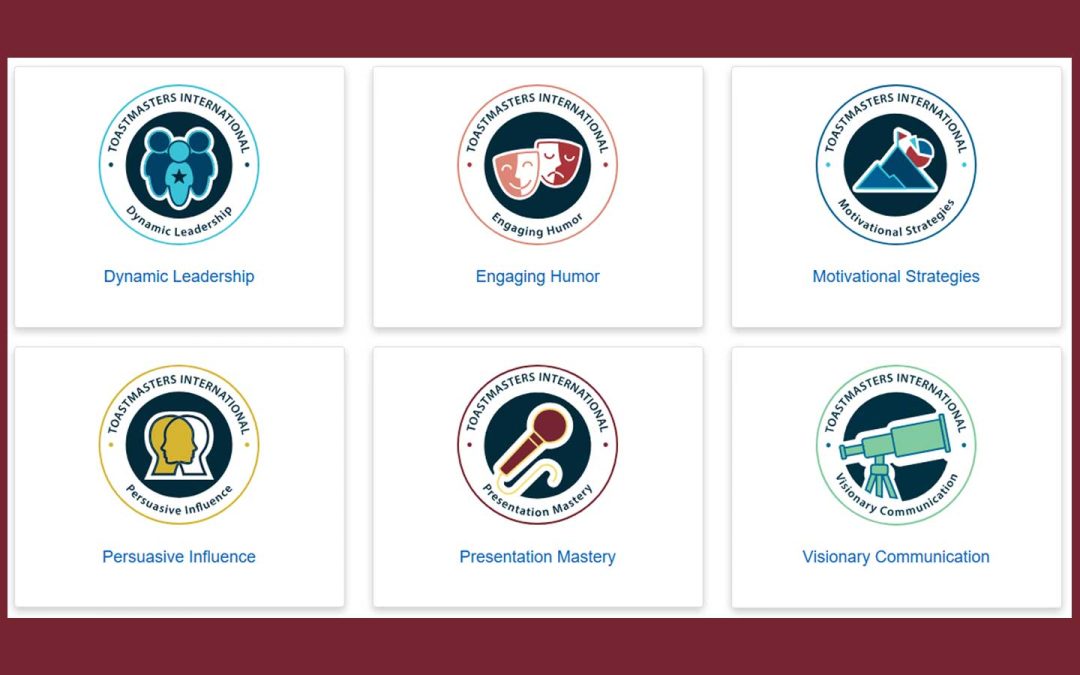
You Choose Your Own Path. Rather than one-size-fits-all lessons, Pathways offers a selection of learning paths, each built around a different theme — from persuasive speaking to leadership development to motivating others. An online assessment helps point you toward the paths that best match your goals, though you’re always free to choose whichever one interests you most.
Five Levels, Always Building. Every path is structured the same way underneath: five levels of increasing complexity, so you’re constantly building on what you learned in the level before. It starts with mastering the fundamentals and works up toward genuinely demonstrating expertise.
Base Camp Puts It All at Your Fingertips. Pathways lives online in a system called Base Camp, where you’ll find project materials, speech outlines, evaluation forms, videos, and interactive tools. Prefer paper in hand? Select materials are also available in print. However you like to learn, the program meets you there.
What You’ll Actually Develop
Real Communication Skills. Each project in a path zeroes in on a specific, practical skill — how to structure a message, how to persuade an audience, how to tell a story that actually lands. You’re not memorizing theory; you’re practicing the exact things you’ll use in a meeting, a pitch, or a conversation next week.
Genuine Leadership Ability. Leadership, at its core, is the art of getting people to work with you toward something. Pathways builds this right alongside your speaking skills — you’ll practice organizing, coordinating, and guiding others, skills that carry directly into club roles, workplace projects, and beyond.
A Sense of Momentum. Because levels build on each other and completions are recognized along the way, you always know where you stand and what’s next. It’s a structured climb, not an open-ended slog — most members find that clarity keeps them motivated long after the initial excitement of joining wears off.
How Glen Abbey Makes It Easier
You’re Never Doing It Alone. New members are paired with a mentor for their first few speeches — someone to answer your questions and help you make sense of Base Camp before you’re navigating it solo..
Feedback From People Who’ve Been There. Every project you complete gets real, thoughtful evaluation from fellow members — many of whom have worked through the exact same projects themselves and remember what tripped them up.
A Club Built Around the Program. Our meeting structure — from Table Topics to prepared speeches to formal evaluations — exists specifically to give you regular, low-pressure reps at the skills Pathways is asking you to build. The program and the club work together, not as two separate things you’re juggling.
Your Path Starts With One Project
You don’t need to have your whole journey mapped out to begin. Most members start with a single project — often called the Ice Breaker — and let the rest of the path reveal itself as they go.
Ever wished you could speak up in a meeting without your heart racing? Or pictured yourself walking into a room and actually commanding it, instead of hoping nobody calls on you?
That confident version of you isn’t a personality trait some people are born with and others aren’t. It’s a skill. And at Glen Abbey Toastmasters, it’s one you build step by step, at your own pace, surrounded by people who genuinely want to see you succeed.
What Confident Voice Really Means
It’s Not About Being Loud. Confidence isn’t volume — it’s clarity. It’s knowing what you want to say and trusting yourself to say it, whether you’re in a boardroom, at a family dinner, or giving a toast at a wedding.
It Shows Up Everywhere, Not Just On Stage. The confidence you build here doesn’t stay in the meeting room. Members tell us it shows up in job interviews, difficult conversations, client pitches, and even just speaking up in a crowded room without the usual knot in their stomach.
It’s Built, Not Found. You don’t need to feel confident before you start. You need to start, and the confidence catches up. That’s the whole model — practice first, feeling follows.
Why Our Club
A Close-Knit Group, On Purpose. With around 20 members, we’ve kept things intentionally small. You’ll get real opportunities to participate and grow — nobody disappears into the back row here.
A Track Record That Speaks for Itself. We’ve proudly held President’s Distinguished Club status — the highest honor in the Toastmasters Distinguished Club Program — year after year. That’s not a badge we chase for its own sake; it reflects the quality of experience our members actually have.
Professional, Friendly, and Genuinely Fun. We’re known for a supportive learning atmosphere — the kind of place where it’s safe to try something, stumble a little, and grow from it. Nobody’s grading you against perfection.
How Confidence Actually Builds Here
Small Roles First. New members don’t get handed a speech assignment on day one. You’ll start with simpler roles — Table Topics participant, Quizmaster, Grammarian — low-stakes ways to get comfortable being “on” in front of the room.
Real, Constructive Feedback. After every prepared speech, a fellow member delivers a thoughtful evaluation. Not criticism — coaching. It’s this steady stream of honest, kind feedback that puts you on the fast track to real improvement.
A Structured Path Forward. Within your first few weeks, you’re introduced to the Toastmasters Pathways program, a self-paced curriculum that guides you from your very first “Ice Breaker” speech through increasingly ambitious projects — always at a pace that works for you.
Your Voice Is Already In There
You don’t need to arrive as a polished speaker. You just need to show up. The club, the structure, and the people around you do the rest — one meeting, one small win, one slightly-less-nervous moment at a time.
Glen Abbey Toastmasters kicks off our new season on September 2nd, and we’d love for you to be here. Whether you’ve been curious about Toastmasters for months (or years — no judgment) or you just discovered us, September is the perfect time to walk through the door for the first time.
We’ve got a calendar packed with themed meetings, speech projects, leadership opportunities, and yes, more than a few laughs.
What Actually Happens When You Show Up
No Pressure, Just Watch – As a guest, you’re welcome to simply sit back and take it all in. Nobody’s going to hand you a microphone before you’re ready.
Jump In If You Feel Brave – Curious what it’s like to think on your feet? Table Topics gives guests the option to try a one-minute impromptu speech. Totally optional — but a lot of people surprise themselves.
A Room Full of People Who Get It. With around 20 members, we’re intentionally close-knit. You won’t get lost in the crowd, and you won’t be the only new face for long — September brings a whole wave of newcomers just like you.
Making It Official
Attend Up To Three Meetings For Free. Lots of time to check us out before you deciding if we are the right club for you.
Getting Started Is Simple. Once you become a member, our Vice President of Education will help you find your footing in the Toastmasters Pathways program right from week one.
A Mentor Has Your Back. Once you do join, you’re paired with a mentor for your first few speeches — someone to answer questions and cheer you on as you get your footing.
Your Confident Voice Is Waiting
September 2nd isn’t just another meeting on the calendar — it’s a natural on-ramp. A whole club of people who once felt exactly the way you might feel right now, standing at the door, wondering if they should walk in.
Join Us for Our Club Speech & Table Topics Contests 🎙️
We are excited for the Club’s International Speech Contest and Table Topics Contest, an evening that celebrates clear thinking, compelling ideas, and confident delivery.
Experience the excitement of fast-paced Table Topics, where speakers think on their feet, followed by prepared speeches designed to inform, inspire, and move the audience. Each speech reflects a key milestone in a Toastmasters journey and offers valuable takeaways for everyone attending.
Whether you’re competing, cheering on a speaker, or simply curious about Toastmasters, we invite you to join us and experience the energy, growth, and camaraderie firsthand.
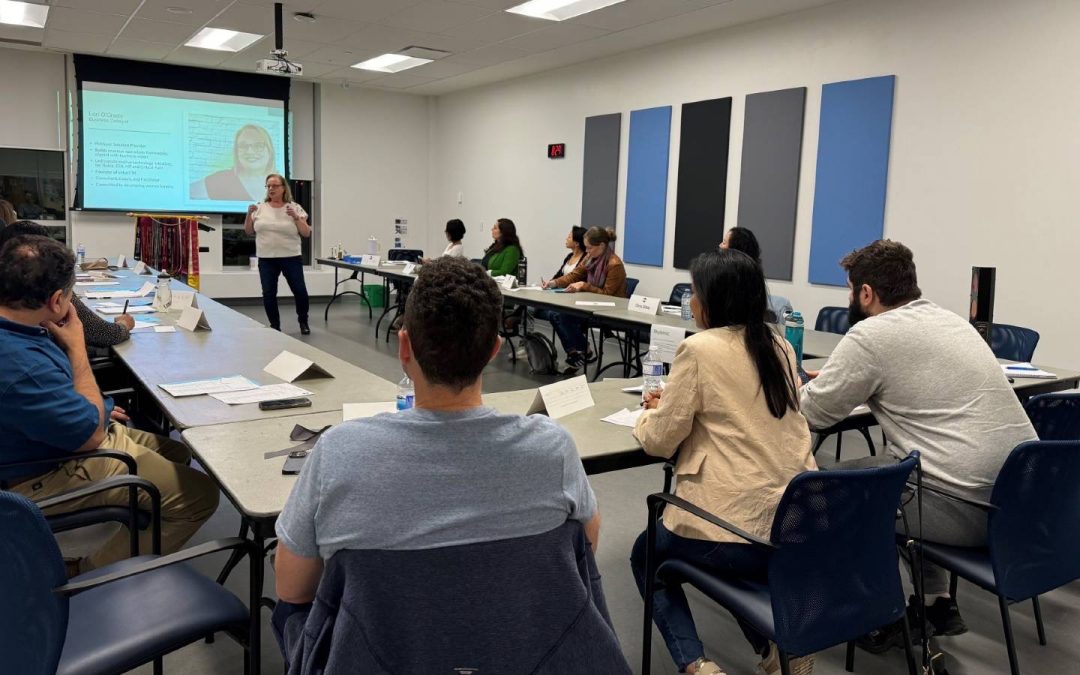
We’re back and better than ever! After a refreshing summer break, our Toastmasters club is excited to resume meetings in hybrid mode—alternating between online and in-person sessions. This format offers the best of both worlds, making it easier for everyone to stay connected and engaged.
Whether you’re joining us from the comfort of your home or experiencing the thrill of in-person speeches, it’s time to bring your energy, ideas, and enthusiasm to the table. Let’s make 2024-25 a year of growth, connection, and powerful storytelling. Get ready, roll up your sleeves, and let’s inspire one another!
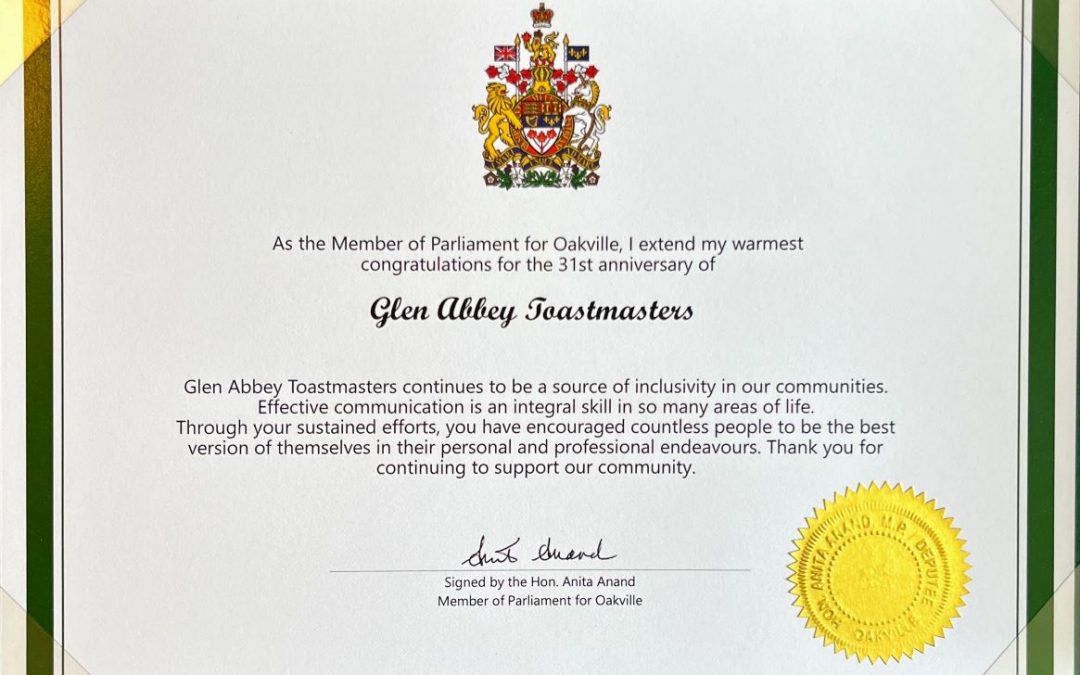
The Honorable Anita Anand, MP for the riding that Glen Abbey Toastmasters (GATM) calls home, has recognised us for our 30+ years of communication and leadership training.
Over the past three decades, we’ve helped countless members transform from nervous to confident speakers.
Thank you to every member, past and present.
Here’s to many more years of growth, learning, and success together!
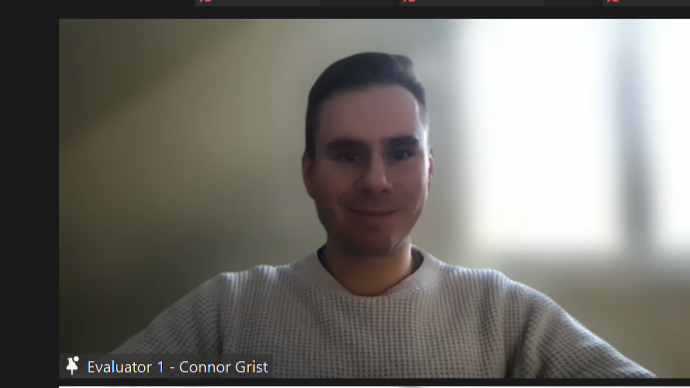
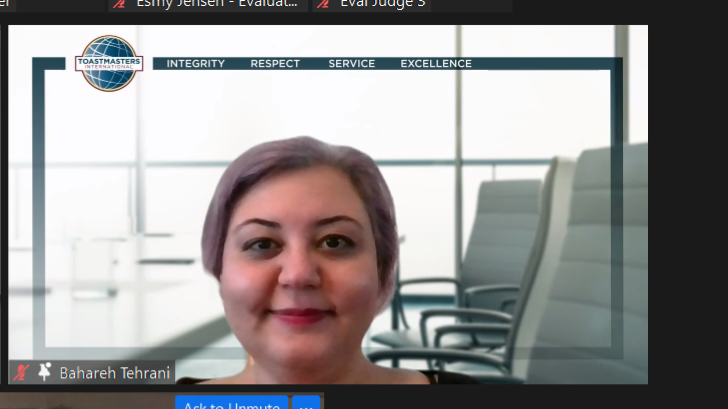
Our club is proud to announce that Toastmaster Connor Grist, our immediate past President, won first place in the Area 83 Evaluation contest… And, Toastmaster Bahareh Tehrani, our past-part president, placed second in the Area 83 international speech contest.
It’s Monday morning. You just got back from your exciting weekend and are about to begin your work week. And right then dreading going to work with the following thoughts crossing your mind:
“Oh man I really don’t want to do this”
“Okay here we go another week, [insert your name] brace for impact”
“Its just same stuff different day”
“Can someone get me out of this situation”
And perhaps, if you are like many Canadians who buy the lottery and had missed the Friday night draw, you are probably thinking, “I wish I will win the lottery someday”.
First off, you are not alone. Specifically, on Monday, workers are only 30% productive, 50% of people are late to work according to the FactSite. In fact, there is a scientific term for this phenomenon known as “Monday blues”.
Most importantly, lets talk about how you can win the Friday night jackpot aka “lottery” so you don’t have to think about “I wish I will win the lottery someday”. That someday is today. You are probably thinking how is that possible. So, buckle up and hear me out on this.
1. Your odds of winning the lottery
Your chance of getting all the 7/7 numbers on the OLG Lotto Max Main draw are 1 in 33,294,800. And your chance of getting all the 6/6 numbers on the OLG Lotto 6/49 Main draw are 1 in 13,983,816. So in simpler terms if you buy a $5 Lotto Max ticket, you have a 0.000003% chance that you will get all the 7 numbers. And if you buy a $3 Lotto 6/49 ticket, you have 0.000007% chance of getting all the 6 numbers.
2. You are already lucky
By the time you are reading this blog, you are 1 in 8,013,662,236 (and counting) lucky individual who is still alive on this planet Earth. And chances are you may or may not have contracted COVID-19 virus but are still fortunate to be NOT one of the 6,804,491 who passed away due to COVID-19 virus. And also you are NOT one of the 124,018 (and counting) who passed away today alone. May their soul rest in peace and may your soul feels lucky. You may not realize but you have already won the bigger lottery. From a macroscopic perspective, your odds of winning the OLG lottery are much higher then your odds of surviving today. So if you woke up today and are alive you won the lottery with higher odds and therefore you should celebrate. Congratulations on the big win!
3. You are already rich
I know some of you, as you are reading it, are probably rolling their eyes and thinking well “duh everyone survives”. I want the money jackpot so that I can be on the cloud 9. If you are reading this blog by now, the chances are you have roof over your head, food on the table and clothes to cover your body. And more importantly if you have more the $6.85 in your pocket today you are part of the lucky 53% of worlds population who does NOT live below $6.85 per day poverty line. In fact, 84% of worlds population lives on less then $30 per day, so if you have more then $30 today you are part of the elite club of 16% worlds population that is already wealthy and have their basic needs met. Congratulations, in case you didn’t know, you are rich. About half of worlds population is struggling to have their basic necessities covered, and yet we are still upset when our barista messes up our coffee order.
You have already won the big lottery, you are already rich and have good health. So what more do you need? I suggest you be happy as you have a reason to not to. If you wake up tomorrow, smile and be grateful for everything you have when half of the worlds population is struggling to have their ends meet. And in case you happened to have a bad day, don’t forget you have already won the biggest lottery you possibly could.
An incredibly fun evening tonight as we celebrated two important things:
Theme: Our World
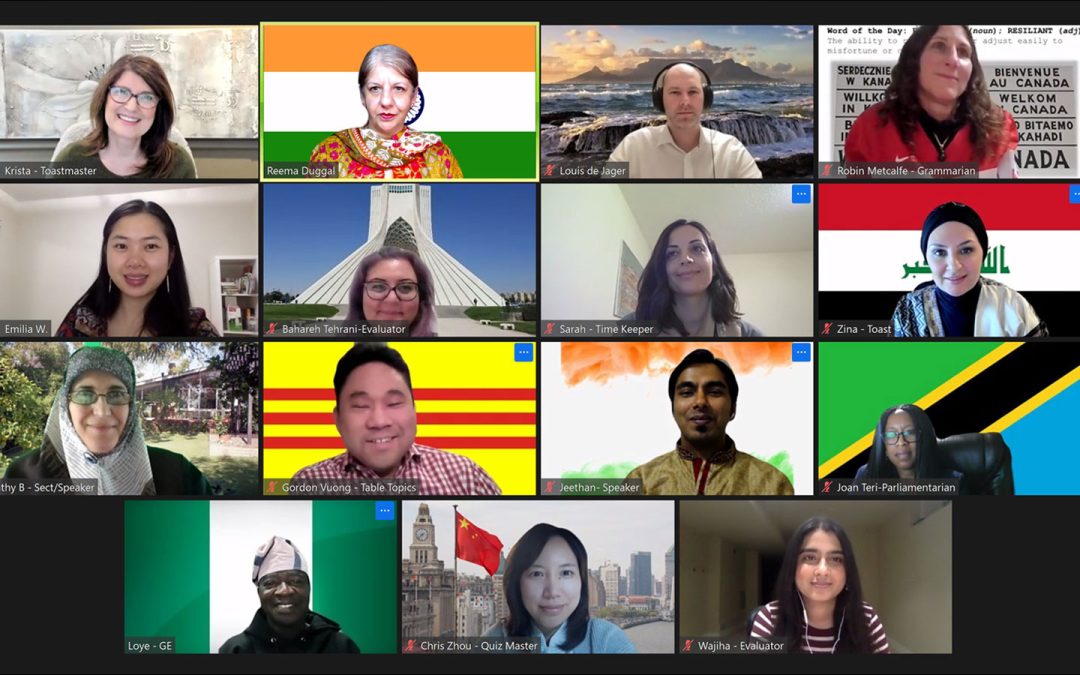
The theme tonight chosen by Chair Reema Duggal focused on what makes Glen Abbey Toastmasters so special. The culture, the respect, and the diversity of our global experiences that we share with each other every single week. Members were asked come to the meeting dressed in their home country’s traditional dress and share what makes the country they were born in so special. And they did.
With a twist, spurred on by Table Topics Master Gordon Vuong – we held a bilingual Table topics. Members spoke their answers in their native tongue and in English. Really inspiring to hear speakers in many languages tonight – followed by English translations. And then Toastmaster Krista Rowan shared her own language that she spoke with her mother! And finally, General Evaluator Loye Fagbemi spoke about the language his hat speaks (marital status) based on what side it is folded on.
30 Years
It was 30 years ago today that Glen Abbey Toastmasters had their first meeting at Glen Abbey Community Center. The club chartered shortly thereafter. We spoke about the great things that Glen Abbey Toastmasters does for people.
Kathy Bullock spoke about her Pathways project to write 8 blog posts in a month – and what she learned.
Jeethan Tellis spoke about his Toastmasters Journey from his first meeting to today as GATM Vice President Education.
——-
While it was 30 years since our first meeting, the plan is to celebrate at our Charter Party later in May/June. Hopefully it will be in person!
You’ve watched every episode, eyes riveted on the television. Finally, the real killer is about to be caught by the detective. He is shut behind bars. The camera zooms in on a slanted grin breaking out on his face. The scene cuts to a dusky close up on another figure, and you see him hiding the murder weapon under the doghouse in the backyard. Oh! They’ve captured the wrong person. Then the credits roll. Yikes! What will happen next? You worry and wonder.
This kind of ending is known as a cliff-hanger – leaving us in suspense for what will happen next. If this is the end of episode 11 in a 12-episode show, you will spend the week speculating what will happen, but you are assured you’ll find out in the finale. But what if that was how the finale ended? Likely you’d feel peeved. Bring on season two, you hope.
Audiences enjoy closure because it makes us feel satisfied the story reached where it should reach. The central premise of the show is answered. Did the detective catch the killer? Did she say yes to her first love? Did the family resolve their differences?1 Movies, films and fiction offer diverse kinds of endings: happy, sad, tragic. 2 Some clever authors know how to wrap up the plot, but still end, if not on a cliff-hanger, at least on a question that hints at a sequel.
Endings are so important that fans will ditch a series if they are dissatisfied with it, and many won’t even begin to watch if others have reassured them the ending was terrible.
So, endings matter.
And no less to Toastmasters.
A speech has a different responsibility than the movies, tv series and novels I’ve referred to above. A speaker needs to give the audience closure. There is no cliff-hanger moment for a good speech.
Toastmaster’s Best Speakers Series advice on endings is that they are crucial because they are the last thing the audience remembers about your speech. 3
Suggesting a signal that you are to end, with phrases such as “in conclusion,” or “to sum up,” the manual gives six different options for ending a speech:
Use a quotation that dramatizes your main points
Tell a short story or anecdote related to your main message
Call for action
Ask a rhetorical question
Refer to the beginning of your speech
Summarise your main points.
Now that you understand that a speech can’t trail off into the distance, that it needs to be tied up in a bow, let’s hear Henry Wadsworth Longfellow’s adage: “Great is the art of the beginning, but greater is the art of the ending.”
This week’s word of the day has exposed how behind schedule I am with my alleged twice-weekly blog posts. I’d appreciate it if someone would hit the pause button on life, so my yen for blogging can be satisfied.
Do I get an award for three week’s worth of words of the day in two sentences?
This week our grammarian proposed “exposed” as the word of the day, to match the meeting theme, which was about how showing one’s vulnerability is a strength for leaders, in spite of it typically being seen as a weakness.
This idea reminded me of one of my favourite stories about a famous Muslim scholar named Malik ibn Anas, known as Imam Malik. He was born in Medina, now in Saudi Arabia, in 711, and passed away in 795. Imam Malik founded a school of law whose rulings became widespread throughout North Africa, Al-Andalus (Muslim Spain), Egypt, and parts of Syria, Yemen, Sudan, and Iraq. The school of law takes his name, Maliki law, and is still in use today.
The story goes like this: Once a man travelled a long distance to ask Imam Malik some questions. More specifically, he asked Imam Malik forty questions. Imam Malik answered four of these questions. And what about the other 36? To these he replied, “I don’t know.”
The man was taken aback, ““What should I tell people about these 36 questions for which you said, ‘I don’t know’?” Imam Malik replied that the man should tell the people that Malik says: “I don’t know,” “I don’t know,” “I don’t know.”
I wonder if Imam Malik said that with a straight face. The latent comedy hides the wisdom of not being afraid to be vulnerable, or exposed, in public. The insight is that only an arrogant person, or one lacking self-esteem, will claim to know everything. Not things we seek, nor need, from a leader.
Imam Malik used to say, “It is from the insight of a man of knowledge that he says: ‘I don’t know’.”
How would a Toastmaster feel about answering “I don’t know” to a series of questions posed by the audience? Stupid, embarrassed, undermining my authority or status – these come to mind. But wise?
Considering that a scholar, who lived as long ago as did Imam Malik, was teaching and demonstrating to his followers that it was part of wisdom to say, “I don’t know,” considering his stature as legal thinker, considering his leadership in the Muslim community, we can appreciate that the issue of vulnerability and leadership is connected to a problem endemic to human nature.
Saying “I don’t know,” showing vulnerability, exposing our lack of understanding – this takes courage.
For that, we all yen for, and I wish us all good luck.
How Can We Incorporate Land Acknowledgements into Our Speeches?
Did you hear the one about the Toastmaster who walked up to the podium and…. A new custom emerged recently that challenges speakers in their attention-getting openings: the land acknowledgement.
I am not advocating a land acknowledgement as a must. Not everyone feels that it is important or necessary. Not everyone will feel comfortable with doing one.
For those of us who want to do a land acknowledgement, how do we, without sapping our sensational openings?
I digress briefly to explain what a land acknowledgement is, and why I believe in them. A land acknowledgement is a short statement to recognize that we live on land that was conquered from indigenous peoples or “purchased” in dubious and insincere colonial treaties. People and city governments across Canada, such as the City of Oakville, adopt a land acknowledgement to recognize past injustices, and as part of reconciliation and good relations to move forward.1
Land acknowledgements typically include naming the treaty and/or indigenous peoples on whose land we live and work. They mention the importance of the land, and finish by thanking the indigenous peoples for sharing the land with us.
Treaty Land Number 14 – The Head of the Lake Purchase
Glen Abbey Toastmasters sits on Treaty Land Number 14, the Head of the Lake Purchase. Signed in 1806, the Mississaugas of the Credit were given £1000 of trade goods and fishing rights along some creeks. 2
Parts of Burlington, Oakville, and Mississauga are in Treaty Land Number 14.
None of us were there in 1806, at this signing. But all of us are beneficiaries of this treaty’s provisions, except the Mississaugas of the Credit. This is why I believe a Land Acknowledgement can be an important step in reconciliation between those of us who are born, or arrived, here recently, and the descendants of those who signed.
Which brings us back full circle to the original challenge: including a land acknowledgement as part of a Toastmaster’s speech.
When Is The Right Time?
Should it be done at the beginning, as is the norm? Should it be done at the end? Can it be part of the speech in the middle?
My spotty practice so far is to give a very short land acknowledgment at the beginning of my speech. I recognize the Chair, our fellow toastmasters, and guests. I tell them that “I begin by acknowledging this land on which I live and work.” I complete a short land acknowledgment by recognizing the Indigenous peoples from here and express my gratitude for being able to be on this land.
I pause for a few seconds, and then launch into the speech, as if I am beginning anew – with the hook, the grabber, the question or quotation to bring the audience to me.
“You like potato and I like potahto, You like tomato and I like tomahto,” croons Louis Armstrong in his duet with Ella Fitzgerald.
As an Australian moving to Canada, with its dual British/American heritage, I spent many years learning the cause of confused looks people would give me.
“Here is my jumper,” I say to my friend, who expects to see a dress and sees instead, a sweater.
“The boxes are in the boot,” I say to my friend, who looks at the shoe rack, puzzled.
“What’s the boot?” you ask. The trunk of the car.
These memories seeped in as the grammarian of this week’s toastmaster’s meeting explained how confused she was with the word of the day. “I have been mis-understanding the meaning of this word my whole life,” she grieved. “I thought it meant ‘intentional,’ like the opposite of ‘inadvertent’, which means ‘unintentional.’” But apparently, she continued, the word meant “heedful or giving attention.”
I also thought the word meant “intentional”. My spidey sense was out. Our toastmaster also has a British colonial heritage – was this a potato/potahto example?
I pulled up the American Merriam-Webster’s dictionary, the Cambridge Dictionary and the Oxford English dictionary, typed in the word “advertent”, and Bingo!
Both the Cambridge and Oxford English dictionaries give “intentional” as a meaning of the word “advertent”. Merriam-Webster says this is not “entirely off base”. They continue: “We have seen some evidence of this use [of the word as ‘intentional’], but it’s not yet well enough established to be entered in our dictionaries.”
Have you ever come across a piece of advice that seems weird at first, but as time passes, you find it meaningful and useful?
This for me, is the advice to speakers to keep a “success diary.” Write down the times that things went well. I used to connect a “success diary” to vainglory. No-one likes an arrogant boaster. How do you record your good talks without becoming the person who lords it over others?
Naysayers are all around us. Why are you doing that? We know you can’t do it that way. Mr X is already doing that, better than you ever could. Your efforts are not necessary, Ms Y has already done it. Like a ton of bricks, we are crushed before we even stand up.
One of the worst negative voices, chipping away at our self-esteem, is our own selves. From a whisper to a roar, we ask ourselves those same questions. You don’t know how to use humour in a speech, why even try it? You always smile awkwardly in the wrong place in your speech.
Remember that time you dropped your notes walking up to the podium?
Rehearsing all the times things went wrong, as we prepare a speech, can be suppressed in the writing and practicing phase. But as the hour draws near, the little unenthusiastic voice becomes destructive, a movie screen of disasters played on fast motion.
The Success Diary
Enter, the “success diary.” The Wonder Woman of enthusiasm, the Hulk of power, the Iron Man of mastery. The little voice rehearses the successes. Yes, there was that time you forgot where you were, and skipped a whole section, but remember that time you stayed on point and had the whole audience clapping loudly at the end? Yes, you did speak monotonously in front of the VP of Management, but remember that time you spoke to a small group of start-up CEOs who appreciated your business acumen.
We have to write down the good times because writing solidifies thought. The naysayer in your head is loud enough to drown out your little enthusiastic voice – the unarrogant voice of achievement. Consolidate your positive voice of experience in a success diary and empower that voice to have the upper hand as you approach the podium. The act of writing pins it in the memory and you can recall it with each step.
“Madame Chair, Fellow Toastmasters, Have you ever wondered why speakers are advised to keep a success diary?”
Harmony is what musicians, families, peace advocates, and speakers all wish for. For what is harmony? It is the “pleasing arrangement of parts,” as Merriam-Websters puts it.
The flute, oboe, trumpet, and violin, their different mechanics of making sounds, blending together to carry us along a smooth journey of sound – unless it’s a heavy metal concert, with discordant sounds, meant to shake us up.
The parents pleasantly, but firmly guiding their kids; their children happily doing what their told, attending classes, and doing their homework on time. Let’s not mention the heavy metal version of dissonance of family life.
Countries trading with each other fairly, respecting borders, and giving their citizens equal access to societies resources. War, police brutality, elite wealth, what are those?
And what about us? The toastmasters? A speech with a catchy opening, clearly defined introduction, three good points with statistics and evidence when needed, humour, anecdotes, wrapping it up with a punchy conclusion and clear recommendations. Deftly delivered by a resonant, harmonious voice. I’ll let you fill in the non-harmonious version of the speech. We’ve all experienced that, no?
Harmony was a gangly girl with feet too big for her legs, elephant ears and hair that wouldn’t lay flat. She was warm, helpful, and people felt inspired after spending time with her. How harmonious was Harmony then?
The meeting Chair introduces your name and speech title, you unmute, anxiousness rising on your sweaty palms in anticipation. You have practiced, you will be fine, your inner voice soothes. You open with a catchy quote, and then stumble over the last few words, your tongue and lips as heavy as treacle. “Huh?” your inner voice, caught unaware, exclaims.
One of the things we often forget to do just before speaking is warm up. Would a sprinter change into her running clothes, walk out of the locker room into the stadium, and dash down the track? Would a swimmer change into his bathing clothes, walk out of the locker room, dive into the pool, and barrel down to the other end? They would not. They warm up before the real event, stretch, breathe, light movements, and the like.
Think about all the muscles used in speaking – the tongue, lips, cheeks, jaws, vocal cords, neck, shoulders – all these need to be warm, loose, pliable and flexible, ready to enunciate those vowel-consonant combinations that are words. So, for a speaker, the need to warm up the muscles is the same as an athlete.
Youtube is full of speech warm up exercises. Anna, from Verba Vocals, has one of my favourite quick warmups https://www.youtube.com/watch?v=hb1Cv7aDXmk]: Mouth and face stretches; lip rolls; tongue routines; chest relaxers; vocal cord warmups; and diaphragm breathing. The finale – tongue twisters: Peter Piper picked a pick of pickled peppers.
If you want your tongue and lips to dance lightly over your words next time you speak, so that the audience is not caught up in deciphering, instead of understanding, the words’ meaning, try warming up before you begin.
Was Glen Abbey Toastmasters rash in holding a regular meeting on Wednesday night? Not at all! It was a deliberate decision made after deliberation. Can you guess what the word of the day was at our meeting? Deliberate carefully before you answer, don’t rush.
If you had to underline different versions of the word of the day, and you underlined “deliberate” and “deliberation,” you would be right! Our grammarian introduced several variations of the word “deliberate,” in its verb, adjectival and adverb forms. Dictionary.com defines the verb “deliberate” in slightly different ways, depending if it is to be used with or without an object.
A. to weigh in the mind; consider (with an object):
to deliberate a question
B. to think carefully or attentively; reflect (used without object):
She deliberated for a long time before giving her decision.
to consult or confer formally:
The jury deliberated for three hours.
As an adjective dictionary.com offers three nuances:
A. carefully weighed or considered; studied; intentional:
a deliberate lie.
B. characterized by deliberation or cautious consideration; careful or slow in deciding:
Moving away from the city and all its advantages required a deliberate decision.
C. leisurely and steady in movement or action; slow and even; unhurried:
moving with a deliberate step.
As an adverb, “deliberately” is connected to the central idea here, which revolves around the idea of doing something slowly, carefully, and on purpose:
A. on purpose; with clear intent:
Is this just bad journalism, or an attempt to deliberately mislead the public?
B. with careful thought or consideration:
The board is committed to moving deliberately on this important initiative.
C. in a calm and unhurried way:
He was careful to move slowly and deliberately so as not to scare them off.
We can see in all these subtle distinctions the connections between being “unhurried” and “intentional.” But unless you knew the meaning of the word in advance, you might be confused by these various uses: What can we see connecting: “She moved the Queen to check the King after deliberating for 15 minutes” to “She walked deliberately into the cold river”?
Unfortunately, there is no method to the madness of English, but if we deliberately memorise the meanings of words, we may deliberate well in our word choices for our speeches.
Glen Abbey Toastmasters is proud to have earned President’s Distinguished Club status for the 22nd year in a row.
What is President’s Distinguished Club status?
It is the highest level Toastmasters Club can achieve in a given year based on the Distinguished Club Program scorecard
What is the Distinguished Club Program?
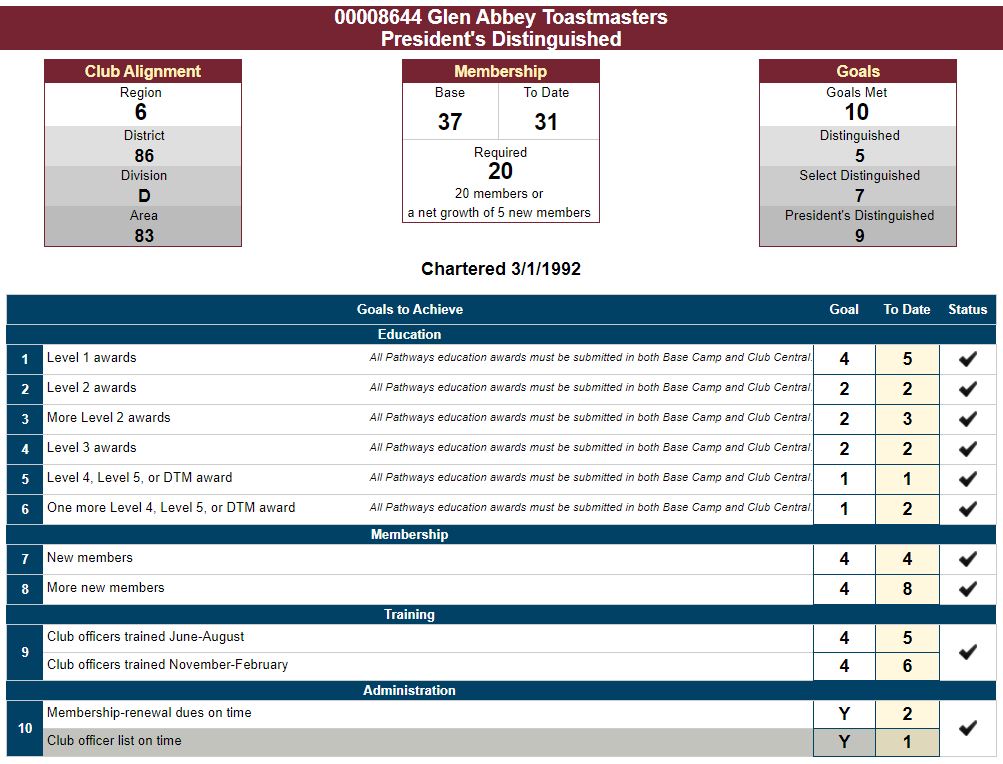
The Distinguished Club Program includes 10 goals that every Toastmasters club in the world strives to achieve each year. The 10 goals are grouped into four areas:
Education: How many members completed various Toastmasters Pathways Education Levels
Membership: How many new, dual, and reinstating members were brought into the club
Training: How many Club Officers attend twice yearly Club Officer Training
Administration: Whether our club submitted dues / renewals on time twice yearly
Understanding The Scoreboard
Glen Abbey Toastmasters achieved 10 goals. Each checkmark on the right counts for one goal / one point.
Why Does It Matter?
Achieving President’s Distinguished status means:
Our club is strong – and has been for a long time
Our members are engaged – and make meetings interesting and memorable
We have a great mix of experienced and new members
Our members are achieving their education goals through a great program and strong club mentorship
Our Club Officers are committed to helping you on your Toastmasters journey.
If you’d like to become a great public speaker – visit our club any time.

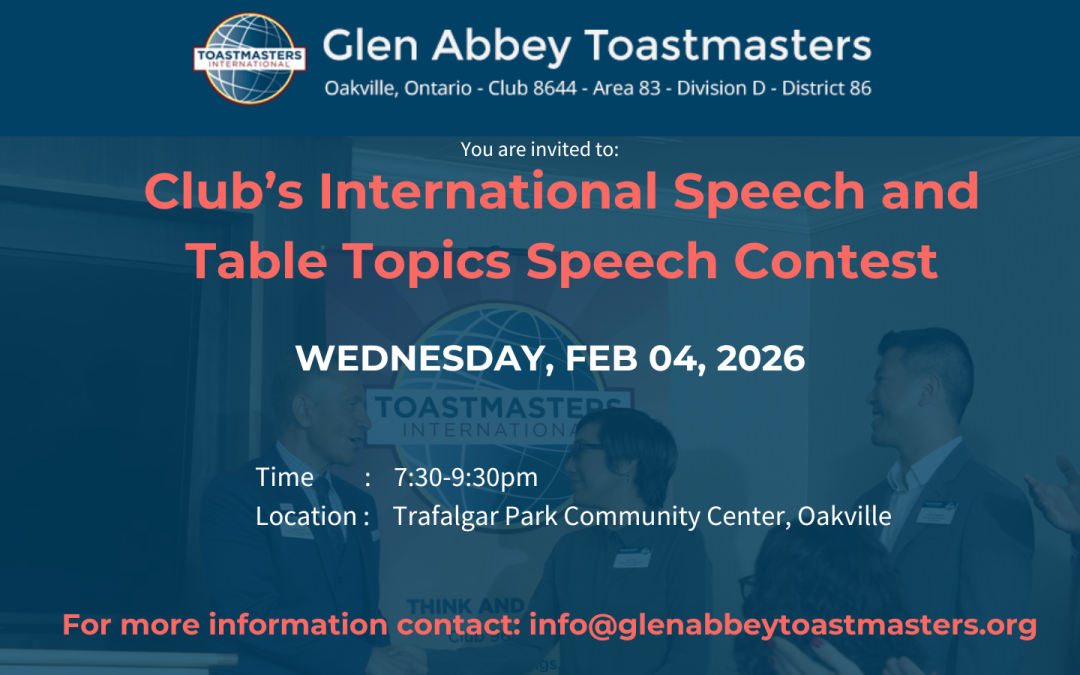
 Location: Trafalgar Community Centre
 Time: 7:30 – 9:30pm, Feb 4th 2026