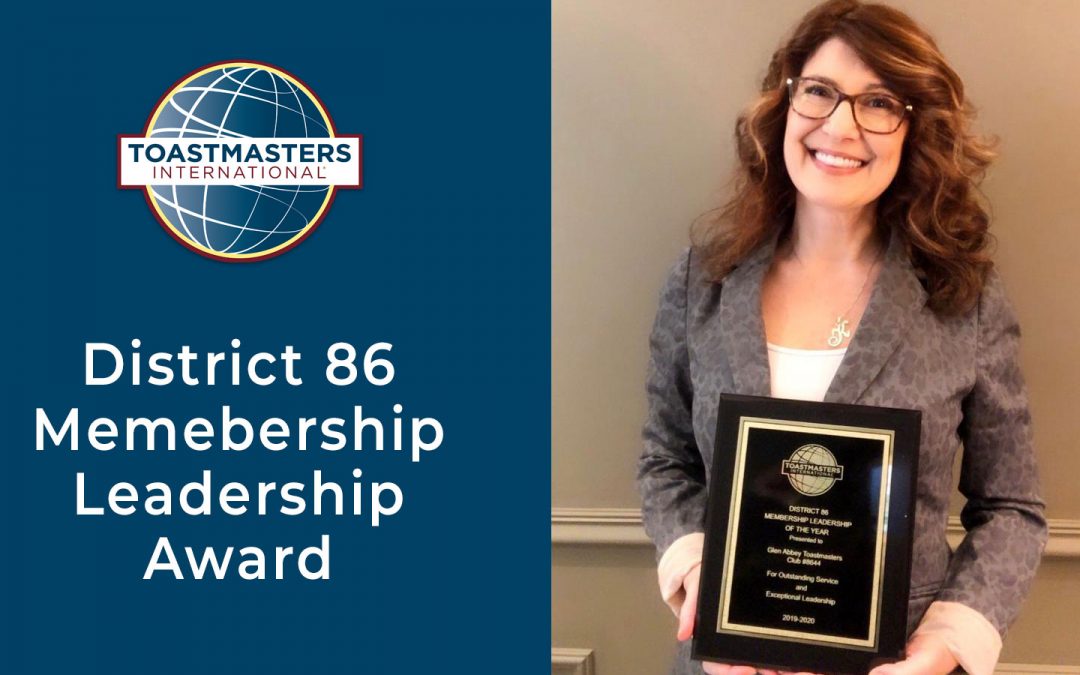
Glen Abbey Toastmasters won the Membership Leadership at the District level in 2019/2020!
The Membership Leadership Award is given to the club with the highest number of points in the Membership Leadership category – clubs who have successfully grown their membership base.
In 2019/2020,18 new members have joined our club despite the challenges that all the clubs because of the pandemic.
Congratulations to GlenAbbey Toastmasters and the 2019/2020 executive team!
When introduced by the Toastmaster, please state the following:
Greetings Mr./Madam Toastmaster, fellow Toastmasters, and guests. As Timer, I will time the table topics speakers, formal speeches, and the evaluations. I will also alert each speaker of the time they have left, using the green, yellow, and red cards, which denote specific times remaining. Thank you Mr./Madam Toastmaster.
Table Topics Speakers should limit their remarks to no more than 2 minutes. • At 30 seconds, I will raise the green card. • At 45 seconds, I will raise the yellow card. • At 1 minute, I will raise the red card.
Ice Breaker speeches should be 4-6 minutes in length. • At 4 minutes, I will raise the green card. • At 5 minutes, I will raise the yellow card. • At 6 minutes, I will raise the red card.
Most other speeches will be 5-7 minutes in length. People giving speeches outside of these times will advise their evaluator, and the evaluator will advise the timekeeper. • At 5 minutes, I will raise the green card. • At 6 minutes, I will raise the yellow card. • At 7 minutes, I will raise the red card.
The individual evaluations should be between 2-3 minutes. • At 2 minutes, I will raise the green card. • At 2 minutes and 30 seconds, I will raise the yellow card. • At 3 minutes, I will raise the red card.
The Chairperson will email you to confirm your assignment. Ask for the evening’s theme to incorporate it in your portion of the program.
Get Speaker Info:
Confirm assignments – speakers should have their own replacements, if necessary
Obtain necessary information – biographical data, manual project number, speech objectives, title, time limits.
Caution speakers to be aware of the time limits for their speech.
Get General Evaluator info:
Confirm his/her assignment
Give him/her information – confirmed speakers and their manual assignments
Obtain information for introduction of General Evaluator.
Plan opening comments, which will set the stage for speakers and enthuse the audience.
Plan introductions for speakers, evaluators and General Evaluator. Use your imagination to avoid hackneyed introductions.
In the case of speaker introductions, your introductory material can include biographical data and /or enumerate the qualifications of the speaker.
The introduction may hint at the subject matter to be presented, but the Toastmaster must never “give away” the essence of the speech.
During the Meeting – After the break
You will be introduced by the Sargent At Arms. Fellow Toastmasters please join me in welcoming Toastmaster ……………………………… [After the recess, the Toastmaster takes control]
During the Prepared Speeches Session SCRIPT
Thank you Mr./Madam Chairman for that flattering introduction. Fellow Toastmasters and guests, I would now like to welcome you to the Prepared Speeches portion of the meeting. This really is the heart of Toastmasters, where members deliver speeches on a subject that they have selected and researched.
My duty here tonight will be to act as your host for this part of the meeting, which consists of a), Prepared speeches b) Evaluations c) Grammarian’s Report and the Quiz Master’s Report.
During the prepared speeches session, our Toastmasters have the opportunity to put their speaking skills to work on a selected subject that they have thoroughly researched. Much time goes into the preparation and practice for these speeches.
During the General Evaluation, Toastmasters receive valuable constructive feedback regarding their speeches and their performance in the various tasks that have been assigned to them during the course of the meeting
Evaluation forms: To assist each speaker and to develop your own listening skills, special feedback forms have been provided to each of you here. These forms are to be used to provide written feedback to the speakers.
There is also a ballot for: a) the Best Speaker, and b) the Best Evaluator.
You are strongly encouraged to use these forms during the meetings.
For the benefit of the guests: [if guests are present and if time permits]
The Toastmasters program is based on curriculum projects called “pathways.” There are 11 specialised learning paths that give Toastmasters the opportunity to build more than 300 unique skillset competencies. Each pathway contains five levels.
These pathways guide the speakers through the basic steps of good public speaking and leadership training, each project building upon the skills learned in the previous speeches.
Tonight we will have the pleasure of listening to ………………. prepared speeches.
Our first speaker will be Evaluated by Toastmaster:____________. Could I ask the evaluator to outline the Speech Manual, the number and the objectives of the speech. If the evaluator does not outline the time please confirm what the timing is so that the timekeeper has it.
Before I introduce our first speaker, I would like to explain timing procedures for our Timekeeper: This speech is …….. minutes long and I would like to have the Green Light at …. minutes, Yellow at …. minutes and Red at …. minutes.
[Explain the reasons for timing speakers and the fact that speakers who do not speak within the assigned time will not be eligible to the vote for “Best Speaker”.]
Our first speaker ….[give relevant information] ………………………………………………… Fellow Toastmasters, please help me welcome our first speaker [Announce “Speaker’s name”, “Speech title”, “Speech title”, “Speaker’s name” ]
[Lead applause upon completion of the speech and thank the speaker]
Thank you Toastmaster ………………………………………………
Please take a minute to give the speaker your written feedback on the special forms provided. [Repeat this process for the second and third speakers.]
REPEAT FOR ALL SPEAKERS
[After the last speech]
This concludes the Prepared Speeches portion for this evening. To summarize, we have heard the following speakers: Speaker Name – Title of Speech Speaker Name – Title of Speech Speaker Name – Title of Speech
Could the Timekeeper give the official time of the speeches?
[At your discretion, exclude from the vote any speakers with timing infractions] Using the appropriate ballot form in front of you, please take a moment to vote for the Best Speaker for the evening. For the benefits of those who are not familiar with the voting procedure, I would like to point out that the best speaker is the speaker who best achieved the required objectives of his/her speech project. Could the Sergeant At Arms please collect the ballots.
Evaluations
Now we have come to the Evaluation part of the evening, the evaluation of Prepared Speeches
Let me begin the evaluation of prepared speeches, which will be done by assigned evaluators. Before I introduce our first evaluator I would like to explain the timing procedures:
Madam/Mr. Timekeeper could you please give the Green light at 2 minutes, the Yellow at 2 minutes and 30 seconds, and the Red at 3 minutes. After the red light, the evaluators will have 30 seconds to wrap up.
[Explain the reasons for timing evaluators and the fact that evaluators who do not speak within the assigned time will not be eligible to the vote for “Best Evaluator”.]
Could the evaluator for speaker #1, Toastmaster …………………kindly give his/her evaluation of Toastmaster ……………………………
Could the evaluator for speaker #2, Toastmaster ……………………kindly give his/her evaluation of Toastmaster……………………………
Could the evaluator for speaker #3, Toastmaster ……………………kindly give his/her evaluation of Toastmaster……………………………
You have just heard three evaluations from:
Toastmaster ………………………………………………………………………………………
Toastmaster………………………………………………………………………………………
Toastmaster……………………………………………………………………………………….
Mr./Madam Timekeeper, may I have the timings for the evaluations? [At your discretion, exclude from the vote any evaluators with timing infractions]
Could you please take a minute to vote for the best evaluator.
Reports
Grammarian’s Report: Could I have the Grammarian’s Report? [Presentation of report]
Quizmasters Report: Could we now hear the Quizmaster’s Report? [Presentation of report]
General Evaluation
Our General Evaluator for this meeting is …………………………………….. Ladies and gentlemen, please join me in welcoming our General Evaluator for this evening’s program, Toastmaster ………………
The Parliamentarian observes the Business Session to keep track of parliamentary procedures in action. The Parliamentarian is usually an experienced Toastmaster who understands Robert’s Rules of order.
The Parliamentarian assists the Chairperson during the business session, upon the Chairperson’s request. He or she can advise on the order of business, how to proceed next, how to handle ambiguous motions, etc., at the Chair’s discretion.
The Parliamentarian gives a brief report at the end of the business session. He or she comments on how well and how fairly the Chairperson carried out the majority’s wishes regarding the business of the day. He or she also offers suggestions for improvement.
Being a Grammarian is truly an exercise in expanding your listening skills. There are three responsibilities.
Introduce a new word to members
Count the hesitations and filler words
Comment on the interesting language used in the meeting
It is a good idea to bring a dictionary.
Prior to the Meeting
Call your Chairperson to find the theme for the evening
Select a word of the day and tie it to the theme if possible. Choose a word that can be used in the context of a Toastmasters meeting. Make sure the word is not too common, in order to expand your fellow Toastmasters’ vocabulary.
Write or type the word on a sheet of paper, in letters large enough to be seen from the back of the room.
During Grammarian Introduction
When introduced, explain the role of the Grammarian.
Introduce a new word to members
State the word
Explain whether it is a noun, a verb, and adjective etc.
State the different meanings
Show how it can be used in a sentence.
Tell people how many times you would like them to strive to use it
Count the hesitations and filler words used by Toastmasters – ums, ahs, you knows, etc
Comment on the creative, imaginitive, and picteresque use of the English language, as well as the misuse of the English language.
Then place the word of the day along with it’s definition and usage into the chat box.
During Evaluation
When called by the General Evaluator, stand by your chair and give your report:
State how many times the word was used and by whom
State how many hesitations and filler words were used
Speak to the creative use of language that you heard. Try to offer the correct usage in every instance in which there was a misuse, instead of only explaining what was wrong.
In this role, it is not necessary to name Toastmasters who make errors. Give special attention to those who used language in great ways!
The Chair will email the roster to everyone, and ask for confirmation of attendance. Evaluators will be asked to confirm their attendance to you. Follow up with them if they do not respond prior to the meeting. Evaluators should have their own replacements, if necessary.
Understanding The Role – Overview
The preparation to evaluate the meeting officers is done throughout the meeting, while the evaluation of evaluators is done only once the evaluators have done their job, towards the end of the meeting.
Even though the preparation starts with the officers (form 1) and ends with the evaluators (form 2), when presenting the report, evaluate the evaluators first, and the officers second.
Evaluating the evaluators should take 3 minutes, and evaluating the officers should take 2 minutes.
Understanding The Role – Evaluating The Meeting Officers
Throughout the meeting, after each officer has spoken, jot down very brief notes on Form 1.
If the officer has done a “proper job,” without anything outstanding, don’t write anything.
Just before presenting your report, look at your notes, and see which ones are “important to mention,” either because the job was very well done, or because the officer missed some important point (examples: a Grammarian’s word that was used many time, a toast that was too long or unclear about the name of the person we were toasting, a Table Topics Master who didn’t give clear instructions, a quizmaster who added a special twist to the questions, a Parliamentarian who did a very thorough job, etc.)
Put a check mark beside the names of the people who have done a “proper job.” During the report, announce that some people have done well and just mention their names. They need to hear they have performed adequately, even without details. The check mark will make it easy to find the names quickly.
Then, give a more detailed account on the 3 to 5 roles and officers that you have identified as “important to mention.”
If you have to emphasize something that was not done well, turn it into a lesson for the future, when other Toastmasters will have to do this role.
This part of the report (done last) should take no more than 2 minutes.
Form 1 – Evaluating the Meeting Officers
Role
Member Name
Notes
Chairperson
Sergeant At Arms
Greeter
Timekeeper
Toast
Grammarian
Quizmaster
Table Topics Master
Educational/Point of View
Parliamentarian
Toastmaster
Other
Understanding The Role – Evaluating the Evaluators
In order to save time, fill your form during the evaluation, while the evaluator is speaking, even if you have to add more notes at the end.
Don’t write sentences, just bullet points.
Put yourself in the shoes of the speaker who was evaluated. How would you feel? Would you know how to perform better the next time? Was the evaluator unclear at times? Would you have liked more suggestions?
It is important to have a few notes in the first column (what was good in the evaluation). If you don’t know what would make it better, don’t write anything and don’t mention this part. Always finish your evaluation of each evaluator with something positive.
Form 2 – Evaluating the Evaluators
Evaluator’s Name
What was good in the evaluation
What would make it better
Something positive about the evaluation
Script – General Evaluator Report
Thank you Toastmaster ……………….. for that nice introduction, and welcome to the last part of the Prepared Speeches Session, the Evaluation.
The function of a General Evaluator is to provide feedback to the meeting’s participants. It is like holding up a mirror to reflect your performance back you. Feedback is an essential element of the learning process and is meant to encourage the drive to excellence and self-improvement.
My report is in 2 parts:
Evaluating the evaluators
Evaluating the meeting officers
Timekeeper, may I have the green at 4 minutes, amber at 5 minutes, and red at 6 minutes.
Give the report following the instructions and using the forms above
At the end of your report, highlight something positive or funny about one aspect – just one – such as the club, the members, the progress of some members, the theme of the evening, the way you feel, etc. You are one of the last people to speak. It is essential to leave the audience with a good feeling about the meeting.
Awards
It is now your role to hand out the awards for Best Table topic, Best Evaluator and Best Speaker. Lead the applause and encourage the crowd to cheer the winners!
The following documents are used at weekly meetings and need to be printed. When you click on them, they will download automatically (probably to your downloads folder). You can either print at home or take to a printer. We have been using UPS at Upper Middle / Third Line or UPS at Upper Middle / 8th Line. But there is no contract with them – so any printer can work.
GATM Door Signs This is a MS Word file and has two door signs on one page. It should be printed on regular photocopy paper and laminated (although we keep losing laminated versions). Perhaps magnetic signs would work better?
GATM Table Cards This is a MS PowerPoint file – with tablecard layout and names. It should be printed on heavy weight white card stock
GATM Evaluation Forms This is a MS Word file – one page evaluation form with 3 evaluations on it. It should be printed on regulary photocopy paper – and perforated at cut points (however this costs more money)
GATM Weekly Winner Certificates This is a pdf file with all the 4 certificates that we normally give out – Best Speaker, Best Evaluator, Best Table Topics, Most Valuable Toastmaster. It should be printed on heavy weight white card stock. The original was done in Photoshop.
Tall Tales Speeches are 3 to 5 minutes in length. They are full of exaggerated truths and unbelievable stories. According to Westside Toastmasters, a Tall Tale should Include the following features: a character with extraordinary abilities and a specific goal; a problem that is solved in a humorous way; a careful blend of exaggerated and credible details; and a comical ending. This is an optional contest that is hosted by some Clubs and Areas – but not at the Division or District level.
Running a Tall Tales Contest is an exciting and rewarding experience. Here are the resources you need to run the contest:
GATM CONTEST MATERIALS – HOW TO RUN A CONTEST
WORKPLAN —
Developed by GATM members, the GATM Speech Contest Workplan includes the:
Developed by GATM members, the GATM Emails document includes sample emails to be sent to:
Participants – Recruiting
Contestants
Judges
Sergeant At Arms
Timers
Ballot Counters
GATM Contest Scripts —
Developed by GATM members, the GATM Tall Tales Contest Script includes the full script for the Tall Tales Contest.
GATM Agenda / Program —
Developed by GATM members, the GATM Speech Contest Agenda is the program for the night.
TMI TALL TALES SPEECH CONTEST KIT – RULES & FORMS
??
Many of the resources for the contest can be found in the members area (login required) of the Toastmasters International site. The Tall Tales Contest Kit from Toastmasters International includes the following:
Table Topics are 1-2 minutes long. They are impromptu speeches given on a topic that the speaker has no prior knowledge of. The contest is held at the Club, Area, Division, and District level.
Running an Table Topics Contest is an exciting and rewarding experience. Here are the resources you need to run the contest:
GATM Contest Materials – How To Run A Contest
Workplan —
Developed by GATM members, the GATM Speech Contest Workplan includes the following:
Developed by GATM members, the GATM Emails document include sample emails to be sent to:
Participants – Recruiting
Contestants
Timers
Sergeant At Arms
Judges
Ballot Counters
GATM Contest Scripts —
The GATM Table Topics Contest Script includes the:
Contest Chair and Chief Judge’s Scripts
GATM Agenda / Program —
Developed by GATM members, the GATM Table Topics Contest Agenda is the program for the night. One program covers both the Humorous and Table Topic contests.
TMI International Speech Contest Kit – Rules and Forms
Many of the resources for the contest can be found in the members area (login required) of the Toastmasters International site. The Table Topics Contest Kit – from Toastmasters International includes the following:
The Evaluation Contest is 2 to 3 minutes in length. All of the evaluation contestants must evaluate the same speech, so a test speaker from outside the club is brought in to present one speech to the entire group. The contestants are then taken from the room and given five minutes to prepare their evaluations. Then they come back into the room, and one by one, deliver their evaluations. The Evaluation Contest is held at the Club, Area, Division, and District level.
Running an Evaluation Contest is an exciting and rewarding experience. Here are the resources you need to run the contest:
GATM Evaluation Contest Kit
Workplan —
Developed by GATM members, the GATM Speech Contest Workplan includes the following:
Developed by GATM members, the GATM emails document includes sample emails to be sent to:
Participants – Recruiting
Contestants
Timers
Sergeant At Arms
Judges
Ballot Counters
GATM Contest Scripts —
Developed by GATM members, the GATM Evaluation Contest Scripts include the:
Contest Chair’s Script
Chief Judge’s Script (coming soon)
GATM Agenda / Program —
Developed by GATM members, the GATM Evaluation Contest Agendais the program for the night. One program covers both the International and Evaluation contests because they are typically held on the same night.
Many of the resources for the contest can be found in the members area (login required) of the Toastmasters International site. The Evaluation Contest Kit – from Toastmasters International includes the following:
Speech Contest Rulebooks
Speech Contestant Profile
Judge’s Certification of Eligibility and Code of Ethics
Humorous Speeches are 5 to 7 minutes long. They should be thematic in nature (having an opening, body, and close), contain original content, use clean humour, and not be a monologue. The Humorous Speech Contest is held at the Club, Area, Division, and District level.
Running a Humorous Speech Contest is an exciting and rewarding experience. Here are the resources you need to run the contest:
GATM CONTEST MATERIALS – HOW TO RUN A CONTEST
WORKPLAN —
Developed by GATM members, the GATM Speech Contest Workplan includes the following:
Developed by GATM members, the GATM emails document includes sample emails to be sent to:
Participants – Recruiting
Contestants
Timers
Sergeant At Arms
Judges
Ballot Counters
GATM Contest Scripts —
The GATM Humorous Speech Contest Script includes the:
Contest Chair and Chief Judge’s Scripts
GATM Agenda / Program —
Developed by GATM members, the GATM Humorous Speech Contest Agenda is the program for the night. One program covers both the Humorous Speech and Table Topic contests.
Many of the resources for the contest can be found in the members area (login required) of the Toastmasters International site. The Humorous Speech Contest Kit from Toastmasters International includes the following:
Speech Contest Rulebooks
Speech Contestant Profile
Speakers Certification of Eligibility and Originality
Judge’s Certification of Eligibility and Code of Ethics
The following list provides a brief description of each of the club officer roles. Elections are held in May each year, and all roles are elected for a one year term. A more complete description can be found by downloading the Club Leadership Handbook from Toastmasters International.
President
As the club’s CEO, managing director, cheerleader and coach you provide helpful and supportive leadership for all of the club’s activities and creating a nurturing learning environment.
Work with all of the clubs leaders to achieve success in the Distinguished Club Program by encouraging educational achievements, building and maintaining membership, attending club officer training, and submitting dues, officer lists and other documents on time.
Serve as the club’s representative at the area, district and international levels. Liaise with the Area Governor and other Area Club Presidents towards mutual success.
Provide leadership and guidance for the club whenever it`s required.
Full role description is here from handbook – start on page 23
Time Commitment: 3-4 hours per week
Vice President Education
Plan club meetings, complete schedules and assignments at least three weeks in advance
Get commitment from club members to achieve their:
Competent Communicator
Advance Communicator Awards
Competent Leadership Award
Advance Leadership Awards.
Promote and help members in Club contests.
Initial member’s Project Completion Records and ensure eligible members fill out their award applications and submit them to Toastmasters International.
Full role description is here from handbook – start on page 26
Time Commitment: 2-3 hours per week
Vice President Membership
The VP Membership is the club’s recruiter and manages the process of bringing in guests and transforming those guests into members.
Initiate contact with guests, making them feel welcome and provide them with a Guest Package as well as the follow-up information they need to join.
Monitor membership levels and strategize with the executive committee about how to overcome any membership challenges should they occur.
Encourage membership retention and growth in the club.
Collect membership applications, along with dues/fees, and put forward the motion for voting at club business sessions. Give member dues/fees to Treasurer.
Register members with Toastmasters International.
Update club membership distribution list and print name tent cards.
Participate in Club Membership Building Programs; Beat the Clock, Smedley Award, Talk Up Toastmasters and Distinguished Club Programs.
Full role description is here from handbook – start on page 28
Time Commitment: 1 to 2 hours on average per week
Vice President Public Relations
The VP PR is responsible for developing and directing publicity programs that inform individual members and the general public about Glen Abbey Toastmasters and Toastmasters International.
Manage GATM info on website – events, blog, photos, achievements, membership info
Manage social media accounts
Create and maintain links to the outside world for GATM – local media, other clubs, community
Work closely with President and VP Membership to create marketing materials for new and existing members
Manage Toastmasters International and GATM brand – make sure all printed and online materials follow standards
Full role description is here from handbook – start on bottom of page 30
Time Commitment: 2-3 hours per week for September / October, then 1-2 hours per week for rest of year – not counting special events that you may decide to take a lead role in.
Secretary
Maintain accurate membership roster and work with treasurer when submitting dues.
Mail and/or update the Toastmasters’ International with current Club Officers.
Handle general club correspondence.
Keep club files including the club charter, Constitution and Bylaws, minutes, resolutions and correspondence.
Record and read meeting minutes.
Full role description is here from handbook – start on page 34
Time Commitment: 2 hours per week at meetings
Treasurer
Prepare a budget to be approved by the executive committee and membership within a month of taking office.
Provide bank with new signature card by July 1st/January 1st.
Prepare and send membership renewal dues/statements to members by August 15th.
Collect dues and ensure submitted to world headquarters by October 1st and at each time a new member joins.
Work with VP-Membership to contact members who have not paid dues.
Keep records of all financial transactions and provide reports to executive.
Make timely deposits of funds received and payments for rent and approved expenses.
Full role description is here from handbook – start on page 37
Time Commitment: 1 hour per week on average
Sergeant at Arms
Maintain Club equipment and keep an adequate number of supplies.
Arrange the room at least 10 minutes before the meeting starts.
Make sure the lectern is in place, evaluation forms and ballots are distribute; ensure the club banner, awards, supply catalog, progress chart and educational material are displayed.
Arrange place cards and make name badges available.
Arrange for food service at meal meetings.
Ensure the meeting starts on time
Collect ballots and tally votes for awards.
Full role description is here from handbook – start on page 42
GATM will be holding it’s Club Officer Elections for the 2021 / 2022 year on May 5, 2021
The following positions make up our Club Executive.
President
Vice-President Education
Vice-President Membership
Vice-President Public Relations
Treasurer
Sargeant At Arms
Secretary
Past President – Appointed: Bahareh Tehrani
Roles/descriptions for each of the roles above can be found in the article below.
We encourage all members to consider running for office as this:
is an excellent way to develop your leadership skills
will provide you valuable recognition in your pursuit of Advanced Leadership Awards, and
will give you the personal satisfaction of being part of a TEAM that makes this great club – Glen Abbey Toastmasters happen.
If you are interested in nominating yourself or someone else, please download this nomination form >.
The election schedule is as follows:
Nomination forms available: March 17, 2021
Nominations close (forms due): April 14, 2021
Announcement of nominees April 21, 2021
Election: May 5, 2021
Round 1 Officer Training (MANDATORY): June X, 2021 – Date TBA
Term begins: July 1, 2021
We hope you will sincerely indicate your interest in the Executive Team to manage and enhance the activities of Glen Abbey Toastmasters. Please contact me if you have any questions.